Choosing the right bicycle manufacturer in China is the single decision that determines whether your next container earns you margin or eats it. Get it right and you have a partner who holds tolerances, ships on schedule and stands behind warranty claims. Get it wrong and you are explaining rusted chainwheels to your dealers eight months after the invoice cleared.
This guide is written for importers, wholesalers and retail groups who buy bicycles in container quantities. It covers how to tell a real factory from a broker, what to inspect before you pay a deposit, how to read a quotation properly, and the trade rules that quietly decide your landed cost.
Why China still anchors the global bicycle supply chain
China remains the centre of gravity for bicycle production, and the reason is not simply labour cost — it is component density. A single industrial cluster will contain frame builders, rim rollers, hub turners, saddle stitchers, tyre plants and paint lines within a short drive of each other. That density is why lead times can be compressed and why a supplier can build a mixed container across a dozen models without subcontracting half the bill of materials abroad.
For a buyer, that translates into three practical advantages: a wider model range from one purchase order, faster response on running changes, and — critically — spare parts availability that matches the bikes you already sold.
Manufacturer, trading company or agent? Know who you are actually buying from
Most sourcing failures begin here. Three very different businesses will all describe themselves as a “bicycle supplier in China,” and the differences show up only when something goes wrong.
- A pure trading company buys from whoever is cheapest that month. Your specification drifts between orders because the underlying factory changes without you being told.
- A single-line factory builds one product type well but cannot fill a mixed container, so you end up managing three suppliers and three shipments.
- A manufacturer-exporter controls production and handles export documentation, consolidation and after-sales as one accountable party.
Ask one question to separate them: “Which of these components do you produce in-house, and which do you source?” An honest manufacturer will answer specifically. A broker will answer vaguely, or will answer “everything.”
The 8-point checklist for vetting a bicycle manufacturer in China
1. Depth of product range
Can the supplier cover complete bicycles, bicycle spare parts and tyres and tubes from one catalogue? Mixed-category loading is where importers recover freight cost. A supplier offering mountain bikes, city bikes, kids’ bikes, folding bikes and BMX alongside a full parts catalogue lets you fill dead space in a container with high-turn inventory instead of air.
2. Documented quality systems
Ask for the certificate, then ask a harder question: what do you test, on what sample frequency, and what do you do with a failed lot? A supplier operating to ISO 9001 should be able to describe frame fatigue testing, brake performance checks, weld inspection and paint adhesion testing without hesitation. Where your market requires it, confirm conformity to ISO 4210 for conventional bicycles or EN 15194 for pedal-assist e-bikes.
3. Spare parts continuity
This is the test most buyers skip. Ask whether the exact hub, freewheel, brake lever and derailleur on your model will still be available in eighteen months. If your bicycle spare parts manufacturer and your bike supplier are the same company, warranty support becomes a purchase order instead of a scavenger hunt.
4. Samples before production
Never approve a production run from a photograph. Order a paid sample, ride it, weigh it, strip the bottom bracket, check the weld beads and measure the actual frame geometry against the drawing. Then send a written approval that references that specific sample by number — it becomes your reference point for any dispute later.
5. MOQ and pricing structure
Minimum order quantities in this industry are usually expressed per model and per colour, not per container, because paint changeovers and tooling drive the cost. Clarify both.
| Quotation element | What to confirm before you accept |
|---|---|
| MOQ | Per model, per colour, and whether mixed models can share a container |
| Incoterm | FOB, CIF or CFR — and which port |
| Currency & validity | Usually USD; quotations often expire in 15–30 days |
| Payment terms | Deposit % and balance trigger (against B/L copy is standard) |
| Lead time | Counted from deposit receipt or from artwork approval — these differ by weeks |
| Packing | Per carton, bikes per carton, carton dimensions and gross weight |
| Spare parts ratio | Free spares supplied per 100 units — negotiable and often forgotten |
6. Container loading competence
Loading is a skill, not a formality. Poor loading costs more than a bad price. As a working planning figure, a 40HQ container typically holds roughly 250–500 adult bicycles depending on wheel size, packing method and whether the bikes ship knocked-down or semi-assembled; kids’ bikes load considerably denser. Treat these as planning ranges only and get a written loading plan for your specific model mix before you commit.
Ask to see photographs of a previous load. You want to see tight, square, edge-protected stacking with no void space at the door.
7. Compliance and documentation
Your customs broker will need a commercial invoice, packing list, bill of lading and certificate of origin that agree with each other exactly. Mismatched HS codes and vague product descriptions are the most common cause of clearance delays. Confirm the supplier has exported to your country before and can produce the paperwork your customs authority expects.
8. Communication discipline
Response time during the quotation stage is your best available predictor of response time during a warranty claim. If replies take four days before you have paid anything, assume they will take longer afterwards.
How to import bicycles from China without surprising your accountant
The quoted unit price is rarely the number that matters. Your landed cost is FOB price plus freight, insurance, duty, port charges, inland transport and — increasingly — trade defence measures.
Trade duties are where importers get caught. The European Union has extended anti-dumping and countervailing measures on electric bicycles originating in China, with anti-dumping rates running from single digits up to roughly 70% depending on the exporter’s status in the original investigation, alongside separate countervailing duties. The UK has maintained its own measures on bicycles and certain bicycle parts. Duties also apply to specified components, which affects assemblers as well as buyers of finished bikes.
There is a further trap for anyone assembling regionally: rules of origin. Assembling in a third country does not automatically change origin. EU anti-circumvention provisions look at the proportion of Chinese-origin parts by value and at the value added during assembly, and certain components — painted or anodised frames and forks among them — attract particular scrutiny.
Practical advice: before you place a large order, confirm three things in writing with a licensed customs broker in your destination market — the applicable HS code, the duty rate including any trade defence measure, and any certification your market requires. This is genuinely worth doing per market, not once globally. Nothing in this article is customs or legal advice, and rates change.
Spare parts: the margin most importers leave on the table
Complete bikes bring customers through the door. Spare parts and accessories keep them coming back, and they usually carry a better percentage margin than the bikes themselves.
A dealer who can supply a replacement freewheel, brake lever, saddle, pedal set, tube or tyre on the same day builds a service reputation his competitors cannot buy. Sourcing complete bicycles and their bicycle parts from the same manufacturer keeps that promise deliverable, because the parts genuinely match the bikes you sold.
The same logic now applies to e-bikes and e-scooters. Electric models add batteries, controllers, motors and chargers to your service obligation — and those are precisely the components where a buyer needs the original manufacturer, not a substitute.
Five red flags worth walking away from
- A price far below everyone else. In bicycles, that difference nearly always sits in tube wall thickness, bearing quality or paint process — all invisible in photographs and all obvious after one wet season.
- Refusal to accept third-party pre-shipment inspection. A confident factory welcomes it.
- No willingness to provide references from your region. Climate and road conditions vary enormously; a supplier with West African or Middle Eastern experience knows things a purely European-facing supplier does not.
- Pressure to pay 100% in advance. A deposit is normal. Full prepayment on a first order is not.
- Vague answers about after-sales. Ask directly what happens if 3% of a container arrives with a defect. If there is no clear process, there is no process.
Frequently asked questions
What is a typical MOQ when buying bicycles from a Chinese manufacturer?
MOQs are normally set per model and per colour rather than per container, because paint and tooling changeovers drive setup cost. Many suppliers allow several models to share one container even when each model sits below a full-load quantity. Always confirm the MOQ per colour, not just per model.
How many bicycles fit into a 40HQ container?
As a planning range, roughly 250–500 adult bicycles, varying with wheel size, packing method and assembly level. Kids’ bikes load significantly denser. Request a model-specific loading plan before finalising your order quantity.
Can a Chinese bicycle manufacturer produce under my own brand?
Yes. OEM and private-label production — your logo, colourways, decals, packaging and catalogue — is standard practice. Confirm artwork approval steps and any tooling or setup charges before production begins.
What certifications should I ask a bicycle manufacturer for?
Start with ISO 9001 for the quality management system, then market-specific product standards: ISO 4210 for conventional bicycles and EN 15194 for pedal-assist e-bikes in Europe. Requirements differ by destination, so verify with your local authority.
Should I buy complete bicycles and spare parts from the same supplier?
Usually yes. It simplifies warranty support, guarantees genuine part compatibility, reduces the number of shipments you manage, and lets you fill container space with high-margin inventory.
How long does production take?
Typically 30–60 days after deposit and artwork approval, depending on order size, model complexity and season. Demand peaks ahead of Q1 and around major trade fairs, so book early if your selling season is fixed.
Working with HongShang
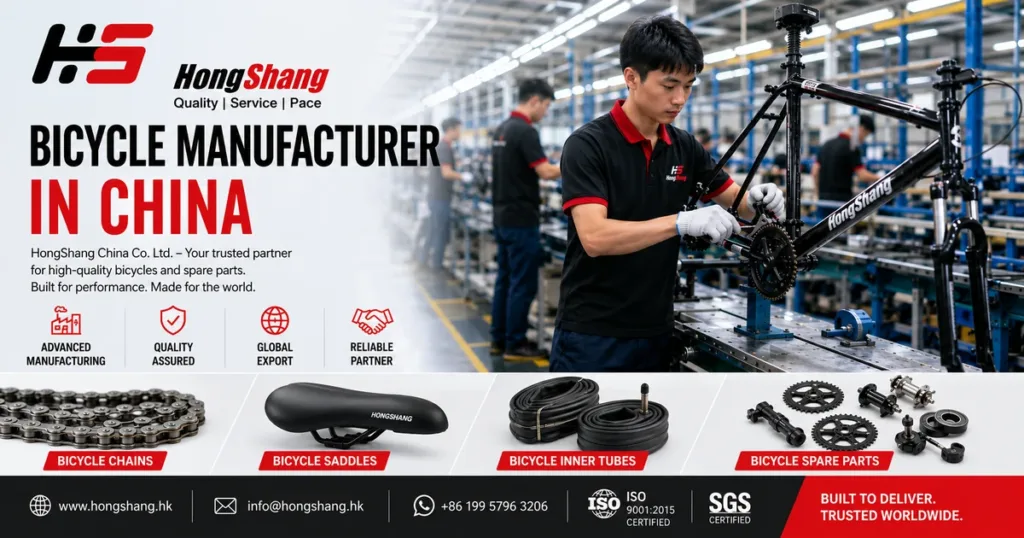
HongShang China Co. Limited manufactures and exports complete bicycles, e-bikes, e-scooters, spare parts, accessories, tyres and tubes to importers worldwide. Production is backed by documented quality control, and the catalogue spans mountain, city, kids’, folding, BMX and freestyle models alongside a deep parts inventory — so one supplier can fill one container.
Send us your model list and target market, and our team will come back with an FOB quotation and a loading plan. Talk to our sourcing team →
Add comment